
A Mining Log Worth Keeping: Five Fields a Day
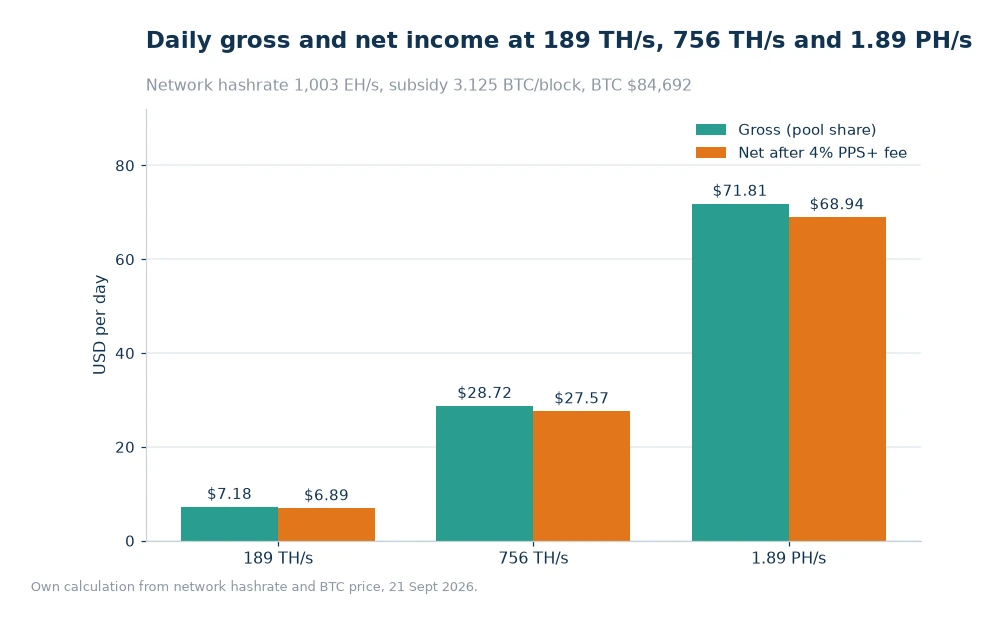
Most mining records fail for a boring reason: the person keeping them had to open four systems to fill in one row. Five fields, taken from one screen at the same time each day, are enough to reconstruct a month later. Start with the number that anchors everything else: at 189 TH/s the pool pays 8.479e-05 BTC a day, $7.18 at $84,692 per BTC and $6.89 after the listed 4% on the block-reward component.

Key takeaways
- 189 TH/s earns 8.479e-05 BTC a day, $7.18 gross and $6.89 net; the log should show both the coin and the dollar figure.
- Record the difficulty reading on the same line as the payout, or the coin figure cannot be checked later.
- At 1.89 PH/s the daily net is $68.94, so a single unrecorded week is nearly $483 of unexplained variance.
- Hourly settlement means the daily total can be rebuilt from the payout history if a day is missed.
Why five fields and not fifteen
A record is useful if it can answer three questions later: how many coins were produced, what they were worth when produced, and what it cost to produce them. Everything else is supporting detail. Hashrate, coins, price, power cost and hours online cover those three questions, and five fields fit in a single row of a spreadsheet or a note.
The temptation is to log everything the dashboard offers. Reported hashrate per card, fan speeds, share difficulty, stale share counts, pool luck, temperature at four sensors: the list is long and the discipline collapses within a fortnight. Pick the five that answer the three questions and add a sixth only when a specific problem demands it.
The five fields, defined
Field one is effective hashrate, taken after any throttling, not the rated figure on the box. Field two is the coins credited in the last 24 hours, read from the payout history rather than estimated. Field three is the price used to value those coins, with the same source every day so the series is comparable.
Field four is kilowatt-hours consumed, from a meter rather than from a calculation, because the gap between the two is often the most interesting number in the row. Field five is hours online, which separates a bad revenue day caused by difficulty from one caused by a machine being down.
Why difficulty belongs on the line
Two miners can see the same coin figure for a month and draw opposite conclusions, because coin output depends on difficulty and both miners' notes are missing it. Add difficulty to the row and the comparison becomes diagnostic: coins flat while difficulty rose means the machines overperformed, coins falling while difficulty was flat means something local broke.
The current reading is 132.76 T with an estimated -2.12% change at the next adjustment. Write the estimate next to the confirmed figure, not instead of it, so a later review can see whether the estimate held. Over a quarter, those two columns tell you more about the reliability of your planning than any single month's total.
What the log looks like at three scales
The revenue figures below are the benchmark a daily row should be checked against. Price is $84,692, network hashrate is 1,003 EH/s, and the listed 4% on the block-reward component is the only deduction.
| Hashrate | BTC per day | Gross per day | Net per day | Net over 30 days |
|---|---|---|---|---|
| 189 TH/s | 0.00008479 | $7.18 | $6.89 | $206.70 |
| 756 TH/s | 0.00033918 | $28.72 | $27.57 | $827.10 |
| 1.89 PH/s | 0.00084787 | $71.81 | $68.94 | $2,068.20 |
The 30-day column is where the log earns its place. A month that closes 8% below the figure for no recorded reason is a signal that either the price used or the uptime was worse than assumed, and the daily rows will show which. Without them, the variance is just a number someone remembers differently.
Worked example
Reconstruct a day from the formula, then check it against the fields a log would contain.
- Network share: 189 divided by 1,003,000,000 TH/s equals 1.884e-07.
- Daily coins: 1.884e-07 multiplied by 450 BTC equals 8.479e-05 BTC.
- Gross value: 8.479e-05 multiplied by $84,692 equals $7.18, which is field three applied to field two.
- Listed fee: 4% of $7.18 is $0.29, leaving $6.89 net.
- Four times the hash at 756 TH/s: 0.00033918 BTC, $28.72 gross, $27.57 net.
- Ten times the hash at 1.89 PH/s: 0.00084787 BTC, $71.81 gross, $2.87 of listed fee, $68.94 net.
- Thirty days at 1.89 PH/s: $2,154.30 gross and $2,068.20 net, the figure the month should close near.
- Uptime check: if the log shows 700 hours instead of 720 across the month, expected net falls by 2.8%, or about $57, before any change in difficulty.
The monthly close, in twenty minutes
At the end of each month, total the coin column, total the dollar column, total the kWh and total the hours. Divide the dollar total by the coin total to get an average price for the month, and divide the power cost by the coin total to get a cost per coin. Those two ratios are the whole story of the month in a form that can be compared with the next one.
Then reconcile against the pool. The payout history should add up to the coin column, and a discrepancy means a day was recorded twice, missed, or included a manual transfer that was not mining income. Finding that in the same month is easy; finding it in March for a transaction from November is not.
Keep the statements together. A multi-currency wallet keeps mining payouts and conversions in one history, which means the monthly close is a matter of totalling rather than joining exports from three platforms. Zero-fee mining payouts also remove a line that would otherwise need explaining every month.
Making the routine survive a busy week
A missed day is recoverable because hourly settlement leaves a payout history that can be rebuilt. A missed fortnight is not, because the price used and the difficulty reading have both moved and the reconstruction becomes guesswork. Set the log entry at a fixed time, attach it to something already done daily, and keep the fields to five.
For operators with more than one site, add a site column rather than a separate file per site. The comparison across sites is the most valuable thing a log produces, and it only exists if the rows share a structure. The ViaBTC Crypto Mining account supports multiple sub-accounts and an app with multi-account management, which makes one row per site practical rather than a second job.
Frequently asked questions
Do I need to log every hour if payouts are hourly?
No. A daily total is enough, since the payout history keeps the hourly detail and the daily row is what gets compared with the formula.
Why record difficulty if the pool already shows it?
Because the pool shows today's figure, while the log preserves the figure that applied when a particular payout was earned, which is what makes a later comparison meaningful.
What is the single most useful ratio in the log?
Power cost divided by coins produced. It combines tariff, efficiency and uptime into one number that can be tracked month to month.
Start with today's row
Open the payout history, copy the last 24 hours of coins, note the hashrate, the price and the meter reading, and write the first row. Five fields, one minute, and a series that will answer questions no dashboard can answer retrospectively.
Sources: published fee and settlement terms[1], with chain inputs read 21 Sept 2026: network hashrate about 1,003 EH/s, difficulty 132.76 T with a next-adjustment estimate of -2.12%, subsidy 3.125 BTC per block over 144 blocks a day, and BTC at $84,692. Figures read 21 Sept 2026, published 22 Oct 2026.