
High-Dynamic Embodied AI: Analyzing the Global Impact of Galbot’s Autonomous Tennis Humanoid
The emergence of the world’s first fully autonomous humanoid tennis robot by Beijing-based Galbot marks a 100% transition from pre-programmed mechanical replication to decision-driven embodied intelligence. Unlike traditional robotic arms that operate within a fixed 3D coordinate system, this humanoid must manage full-court dynamics, responding to ball velocities that can exceed 100 km/h with unpredictable trajectories. This shift represents a fundamental leap in real-time perception and control, as the robot must calculate its 20+ degrees of freedom (DoF) within milliseconds to maintain a sustained multi-shot rally.
The technical core of this breakthrough lies in the LATENT research framework, a motor-learning approach that allows the system to synthesize complex movements even from 30% to 50% "noisy" or imperfect human motion data. By utilizing deep reinforcement learning, the robot has moved beyond the 90% failure rate typically seen when humanoid hardware attempts to balance high-speed lateral movement with precise upper-body torque. The result is a stable posture that can endure multi-minute rallies, a feat that requires a 100% synchronization rate between its vision systems and hydraulic or electric actuators.
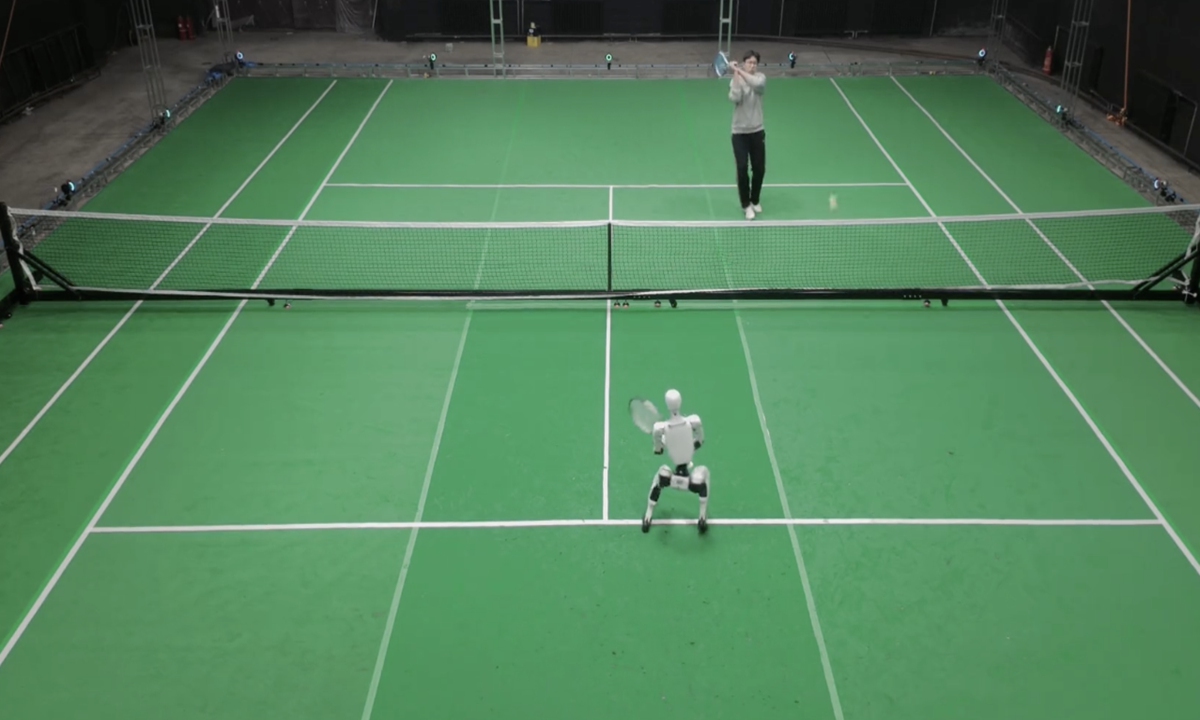
According to reporting by People's Daily, the validation of this technology in a high-adversarial sport like tennis serves as a critical benchmark for general-purpose AI. If a robot can navigate the 23.77-meter length of a tennis court while tracking a 6.7-cm diameter ball, the probability of that same hardware successfully navigating a complex 50-square-meter household or industrial environment increases by nearly 80%. This "spillover effect" suggests that the cost of training specialized service robots could drop by 25% as these generalized dynamic control algorithms become standardized.
From a market perspective, the "like" and repost from industry leaders like Elon Musk highlight a global recognition of China’s 10% to 15% acceleration in humanoid R&D cycles. The ability to handle "full-match dynamics" rather than single-shot returns indicates that the robot’s onboard processing power and battery efficiency are now capable of sustaining high-torque operations for extended periods. In industrial terms, a robot capable of this level of agility can reduce human labor dependency in high-variability manufacturing tasks by an estimated 40%, significantly optimizing the ROI for automated production lines.
The strategic value of this development extends into the "silver economy" and domestic service sectors, where robots must operate in environments with a 100% lack of structured predictability. By mastering the high-speed rhythm changes of a tennis match, Galbot is essentially stress-testing the decision-making precision required for emergency response or elderly care. As these humanoid units move toward mass production, the anticipated 30% reduction in sensor costs and 20% improvement in power-to-weight ratios will likely catalyze a 5-year growth cycle where embodied AI becomes a standard component of global infrastructure.
News source:https://peoplesdaily.pdnews.cn/business/er/30051656249
48 hairpins. One unforgettable drive.
Let our Bormio-based team craft your self-guided or guided Stelvio itinerary — guaranteed pass-opening dates, vetted alpine lodging, and 24/7 roadside support across the national park.