
Before You Sign: Questions That Test a Fragrance Partner at Volume
By the time a large-volume fragrance agreement reaches the signature stage, most of the risk has already been created — in the sampling rounds, the specification documents and the assumptions each side made about the other. The pre-signature conversation is the last cheap moment to surface it. The questions below are the ones that produce usable answers rather than polite ones, grouped by what they actually test: capability, control, ownership and exit.
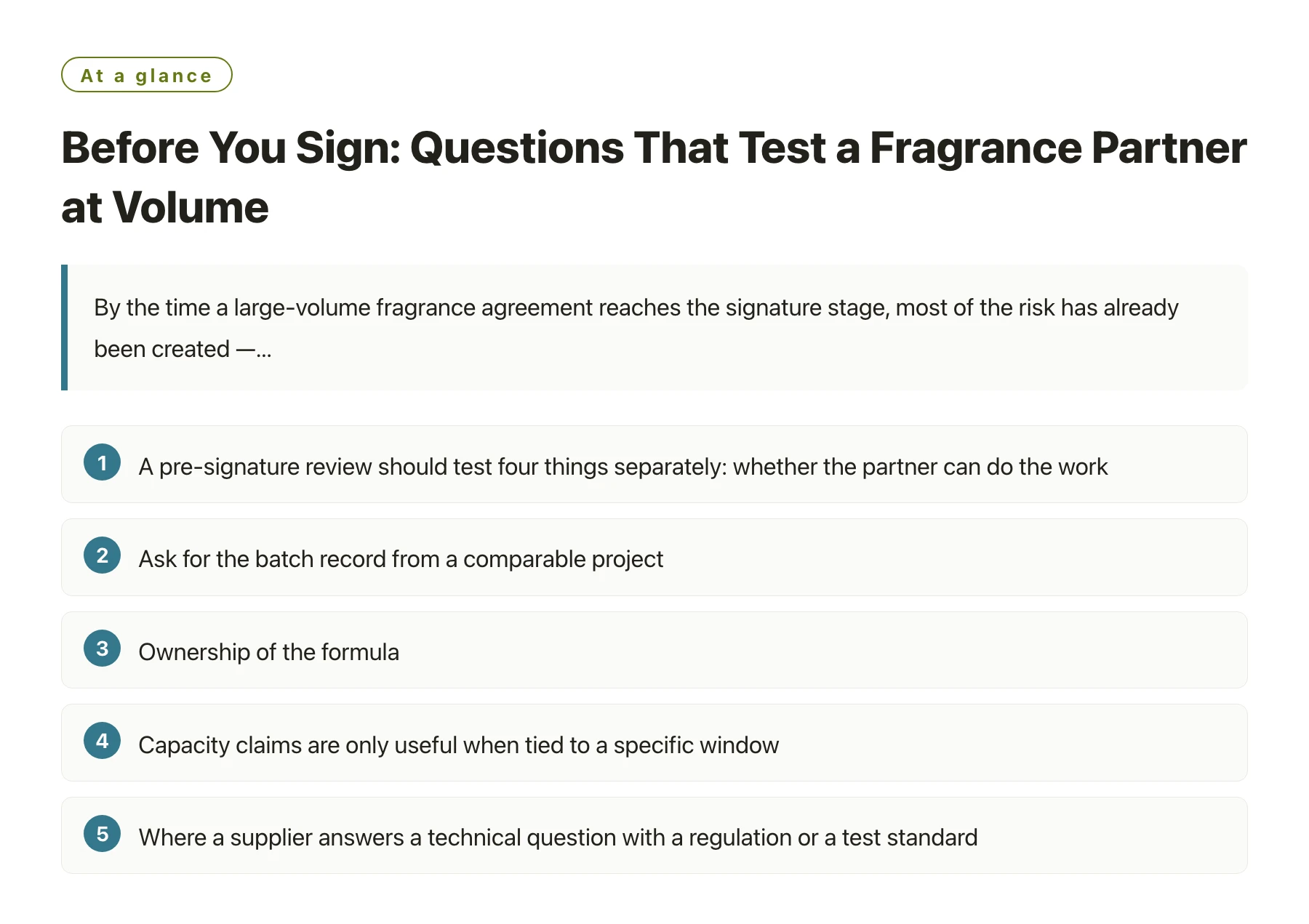
Key takeaways
- A pre-signature review should test four things separately: whether the partner can do the work, whether they can control it repeatedly, who owns what afterwards, and what happens if the relationship ends.
- Ask for the batch record from a comparable project, because a sample proves a formula can exist while a batch record proves it can be repeated.
- Ownership of the formula, the brand name on the mould and the artwork files are three different questions that are often answered as if they were one.
- Capacity claims are only useful when tied to a specific window, a specific line and a named project owner.
- Where a supplier answers a technical question with a regulation or a test standard, that is a stronger signal than any assurance.
- Exit terms — tooling, surplus stock, reference samples and documentation — belong in the agreement, not in a later email.
Procurement teams tend to arrive at the fragrance category with habits formed in other industries. They ask for a price, a lead time, a minimum order quantity and a certification list. All four matter, and none of them reveal whether a programme will survive its second and third seasons.
The complication is that fragrance sits between chemistry and consumer goods. The output cannot be fully specified as a drawing, the input materials are regulated, and the perceived quality of the result is judged by a nose as well as an instrument. That combination makes the questions a buyer asks unusually predictive of how the project will go.
This piece is written from the buyer's side of the table. It assumes a programme large enough that a failed launch would be a serious financial event, and it assumes the reader would rather look slightly pedantic now than explain a problem later.
Questions that test capability, not enthusiasm
Capability questions have a property that is easy to check: they can be answered with a document, a name or a date. Enthusiasm is not a document.
A useful opening is to ask the manufacturer to describe the largest programme they have run that is genuinely comparable to yours, using their OEM/ODM manufacturing services as the frame. Comparable means similar in format, similar in market and similar in volume — not simply large. If nothing comparable exists, that is an answer too, and it changes the risk calculation rather than ending the conversation.
Who owns this project inside the supplier?
Ask for a named programme owner and a named technical contact, plus what happens when either is on leave. In practice, a surprising share of late-stage problems trace back to a project that had no internal owner and drifted between a sales contact and a production planner.
The follow-up question is how escalations work. A supplier who can describe the path from a line problem to a decision-maker has dealt with line problems before.
What does the schedule look like in weeks, not weeks from now?
Lead times are only meaningful against a start date. Ask what the schedule would be if the purchase order were placed on a given Monday, and ask which stage is most likely to move. A partner who names the likely bottleneck — decoration approval, glass availability, a public holiday period — is giving you planning information. A partner who names nothing is giving you a brochure.
Questions that test control and repeatability
The second group is about whether the first good batch can be followed by a second, a tenth and a hundredth that all read the same. This is where accredited testing has a role: stability, packaging compatibility and microbiological checks are standard parts of finished cosmetics testing, and they are the areas where a scale-up problem shows up first [1].
Repeatability is also a documentation question. Ask to see the structure of a batch record — not the confidential content, but the shape of it: what is weighed, what is checked, who signs, and what happens when a check fails. A factory that can show this without preparation has a system. A factory that offers to describe it verbally has a habit.
How is the reference sample used?
Every serious manufacturer keeps an approved reference against which later batches are compared. Ask how yours will be stored, how long it is retained, and who performs the comparison. This single question tends to produce the most useful answer in the whole review, because it reveals whether quality control is a department or a sentence in a proposal.
Which materials in this formula are close to a limit?
The industry's use standards restrict how much of certain materials may appear in a finished product, and those limits differ by product category [2]. Asking which materials in your formula have little headroom does two things: it surfaces reformulation risk while there is still time to design around it, and it shows whether the technical team knows your formula or is reading it for the first time.
Four question groups, and what a solid answer contains
| Group | The question to ask | A solid answer contains | A weak answer sounds like |
|---|---|---|---|
| Capability | Which comparable programme have you run, in this format and this market? | A named project type, the volume band, the stages handled in house and the people responsible | A list of countries served and a general statement about experience |
| Control | How will my approved reference be used on later batches? | A retention period, a named comparison step and what happens when a batch deviates | A promise that every batch is checked |
| Ownership | Who owns the formula, the artwork and the tooling? | A clause by clause split, including what transfers on payment and what never transfers | Assurance that everything belongs to the customer |
| Exit | What happens to tooling, documentation and surplus stock if we stop? | A written process, a cost basis and a timeline for handover | A statement that this situation does not arise |
Notice that none of these four groups is about price. Price is the easiest term to compare and the least informative, because two quotes for the same brief can differ entirely in what they include. Settle the four groups first, then compare money against a scope both sides have described the same way.
A practical habit that costs nothing: send the questionnaire in writing before the meeting and ask for the answers in writing afterwards. Verbal review meetings are useful for reading a room, but a programme that lasts several seasons will be run by people who were not in the room. Written answers also make the second conversation much shorter, because the follow-up questions go straight to the gaps.
Questions that test ownership and the exit
Ownership in this industry is rarely a single question. A formula can belong to the brand, to the manufacturer, or to neither in a way that becomes expensive only at the point of separation. Creative work such as bottle design carries its own layer of protection, and it is worth understanding which parts of your product are protected by which right before you commission them [3].
Exit terms are the least pleasant part of the conversation and the most valuable. Ask what happens to the mould if you move production, whether surplus finished goods can be bought at cost, and whether the documentation needed to make the product elsewhere will be provided. A partner who has an answer is signalling that they expect relationships to end well. That is a commercial signal, not a sentimental one.
Put a floor under the numbers
Where a partner manufactures for brands you will never see, one reassuring detail is a stable operating history and a defined service scope. It is worth reading how a manufacturer describes its own scope on the official Xuelei website and comparing that language with what the agreement actually commits to — the gap between the two is where disputes live. A contract perfume manufacturing in China relationship that covers development, filling and packing under one responsibility is easier to audit than a chain of four suppliers, simply because there are fewer boundaries for information to be lost across.
If any of these answers arrive as reasoning rather than as assertion, note it. It is the best available predictor that the programme will still be running smoothly in year three.
Sources
- SGS: Cosmetics, Personal Care & Household Testing —— Testing, inspection and certification services for cosmetics and personal care, including microbiological, stability and safety testing aligned with cosmetics GMP.
- IFRA Standards Library (International Fragrance Association) —— The IFRA Standards Library lists the restrictions the fragrance industry applies to individual fragrance ingredients, based on safety assessments; it is the reference point for compliant fragrance formulation.
- WIPO — World Intellectual Property Organization —— The UN agency for intellectual property; resources on industrial design and patent protection relevant to product and packaging design.
Frequently asked questions
How long before signing should due diligence on a fragrance manufacturer start?
Long enough to run at least one sample round before the commercial terms are fixed. Sampling tells you more about a partner than any questionnaire, and the answers to the written questions are much easier to evaluate once you have seen how they handle a brief.
What is the single most revealing question to ask a perfume factory?
Ask how the approved reference sample is stored and used to check later batches. It tests quality control, documentation discipline and honesty at the same time, and it cannot be answered well by rehearsing a sales script.
Do I need to know which fragrance materials are restricted before I sign?
You do not need to be the expert, but you should know which materials in your formula carry restrictions and how much headroom each one has. That is the main source of forced reformulation later, and it is far cheaper to design around it at the brief stage.
Should the manufacturing agreement cover tooling and moulds?
Yes. Moulds, decoration plates and printing files are physical and digital assets that outlive the relationship. The agreement should say who owns them, where they are held, and on what terms they can be retrieved if production moves.
How do I compare two fragrance quotes that look very different?
Normalise the scope before comparing money. Ask both suppliers for the same separation of lines — compound, container, closure, decoration, assembly, testing and freight — then compare like with like. Quotes that differ by a wide margin usually differ in scope rather than in efficiency.
Is a larger manufacturer always the safer choice for a volume programme?
Not automatically. Scale helps with capacity and documentation, and it can make a small initial order less appealing to the factory. The relevant question is whether the partner has run something genuinely comparable and can give your project a named owner.
48 hairpins. One unforgettable drive.
Let our Bormio-based team craft your self-guided or guided Stelvio itinerary — guaranteed pass-opening dates, vetted alpine lodging, and 24/7 roadside support across the national park.