
Hourly Settlement: What PPS+ Timing Means for Cash Flow
Hourly settlement turns mining income into 24 credits a day, and the size of each credit is knowable in advance. At 1 PH/s the gross figure is about $1.68 an hour under a PPS+ method, which builds to $40.39 a day and $1,211.68 across 30 days at difficulty 132.76 T. That rhythm is what makes the cash-flow question answerable: you either fund the month from the same month's output or you do not.

Key takeaways
- PPS+ credits arrive every hour at current difficulty, so the credit rate resets when difficulty adjusts rather than being averaged over a payout window.
- At 100 TH/s a credit is about $0.16; at 1 PH/s it is about $1.68, which is $1,211.68 over a 30-day month.
- A shortfall against the expected hourly figure is a fault signal, not a rounding detail — it is the earliest warning a fleet produces.
- PPLNS pays on a different clock: distributions follow the pool's blocks, released after 6 confirmations across the last 5 difficulty rounds.
How one hour of credit is built
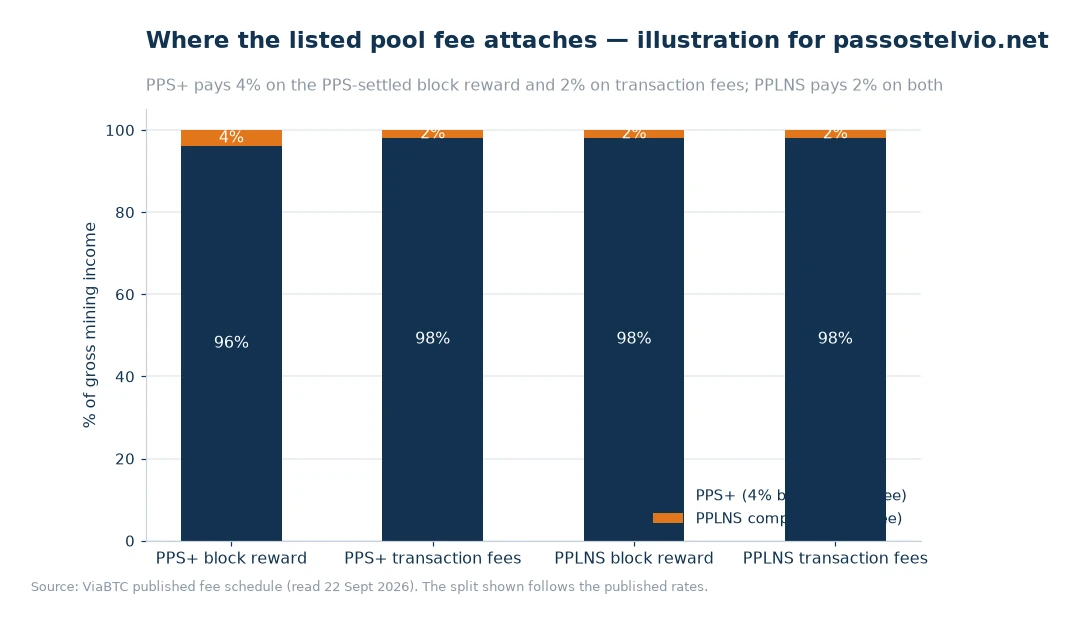
Under PPS+, the block-reward component is settled per accepted share against the difficulty in force at the time, and the balance is paid out every hour. Nothing is held back for a luck window, because the pool has already absorbed that exposure on this component. The transaction-fee side travels through PPLNS logic at a listed 2%, so the hourly credit is dominated by the reward component and topped up by fees as they arrive.
That is why the credit rate is a clean unit of measurement. One PH/s at current difficulty means 0.00001973 BTC an hour, about $1.68. Scale changes the size and not the character: 100 TH/s pays roughly $0.16 an hour, ten times that hashrate pays ten times that credit, and the arithmetic stays linear because the underlying share of network hashrate does.
Why the clock matters as much as the total
Electricity and hosting invoice on fixed dates, usually monthly, and sometimes in advance. Mining income arrives on a curve set by the payment method. The gap between those two curves is working capital, and it is the reason to look at settlement timing separately from the headline fee. A farm whose credits land hourly can pay a monthly power bill from the same month's production; a farm settling after a long window has to bridge the difference from reserves or credit, and every arrangement that bridges it has a cost.
Frequent credits also produce frequent evidence. If 400 TH/s should credit about $0.65 an hour net and a credit lands at half that, the discrepancy is visible within hours rather than at month end when the cause is four weeks old. Treating each credit as a heartbeat turns payout reporting into an uptime sensor, and it costs nothing to adopt.
Where difficulty enters the sequence
A PPS+ rate is quoted against current difficulty, so each adjustment resets the per-hour figure. The next change is estimated at about +1.90%, which trims the hourly credit by roughly the same percentage until the price of the coin moves the other way. A PPLNS distribution, by contrast, is computed over a window that can straddle an adjustment, so the effective rate blends one difficulty period with the next.
| Hashrate | Hourly credit | Daily net | 30-day net | Power cost at $0.06/kWh, 20 J/TH |
|---|---|---|---|---|
| 100 TH/s | About $0.16 | About $3.88 | About $116.31 | $2.88 a day |
| 400 TH/s | About $0.65 | About $15.51 | About $465.30 | $11.52 a day |
| 1 PH/s | About $1.68 gross | About $38.77 | About $1,163.21 | $28.80 a day |
| 10 PH/s | About $16.80 gross | About $387.74 | About $11,632.10 | $288 a day |
Read the last column as the reason hourly settlement is not a luxury. At 400 TH/s the power bill runs at $0.48 an hour while credits arrive at $0.65 an hour, so the operation is cash positive from the first hours of the month rather than from the first payout window.
Worked example: a week at 400 TH/s
Four hundred terahashes produce 0.00018941 BTC a day at current difficulty, which is $16.16 gross and $15.51 after the listed 4% charge on the block-reward component. Divide by 24 and the hourly credit is about $0.65, gross $0.67. Over seven days that is $108.57 net.
Now match it to the cost curve. At 20 J/TH the fleet draws 192 kWh a day, costing $11.52 at $0.06/kWh and $80.64 across the week. The margin is $27.93 for the week, about $3.99 a day and $0.166 an hour — small per credit, but already funded, because the electricity is being paid out of revenue that has cleared. Six hours of outage in that week would cost roughly $3.90 of that margin, which is why outage hours belong in the cash-flow sheet rather than in a separate incident log.
Choosing a settlement clock on purpose
Cash-flow planning starts with deciding when you need the money, not with which rate looks smaller. If power, hosting and staff are paid monthly from mining revenue, an hourly clock removes the financing step in the middle of the month. If the fleet runs on reserves and the goal is the lowest possible cost per coin, a lower listed rate with a longer settlement window is a deliberate trade of timing for rate.
The rules behind both options are published rather than inferred. The ViaBTC Pool Fees page lists both rates against the components they apply to and states that PPS+ settles hourly at current difficulty, which is the sentence your cash-flow model needs. From there the balances are easier to manage in one place: a multi-currency wallet on the same account lets settled income sit, convert or leave without a transfer step, and for a month that runs ahead of its invoices, Collateral-Pledged Loans are the documented route to liquidity against holdings rather than against future payouts.
Frequently asked questions
Does hourly settlement cost more in fees?
No. The listed rate applies to the settled component, not to the number of payouts, so 24 credits a day are charged the same percentage as one monthly credit would be.
What happens to my credit when difficulty adjusts?
It is recalculated at the new difficulty, since PPS+ settles at current difficulty rather than over a trailing window. The next adjustment is estimated at about +1.90%.
Can I get hourly income while on PPLNS?
Not from the reward side. PPLNS releases distributions after the pool's block receives six confirmations, weighted over the last five difficulty rounds, so the clock follows the pool's blocks.
How large must a fleet be before this matters?
Any size where a monthly invoice has to be covered by mining revenue. At 100 TH/s the hourly credit is about $0.16, and the point is the timing of the whole balance rather than the size of each deposit.
Build the month around the credit rate
Write your hourly credit on one line, your hourly power cost on the next, and subtract. If the result is positive, the operation funds itself from the first hours of every month and the only remaining work is reconciliation. If it is negative, no settlement schedule will fix it, and the fix is a cheaper tariff, more efficient hardware or a smaller fleet. Review the pair after each difficulty change, and keep the payout history next to the cost record so the comparison never has to be reconstructed from memory.
Data and sources: the ViaBTC published fee schedule for the listed 4% and 2% rates and the hourly PPS+ settlement rule[1], the wallet product page for balance management[2], and the loan product page for liquidity against holdings. Difficulty, network hashrate and the BTC price were read 22 Sept 2026, and appear throughout as 132.76 T, about 950.3 EH/s and $85,294. Power figures are worked examples, not quotes.